
If your Whirlpool washer keeps adding time or seems stuck on one part of the cycle, the most likely explanations are an unbalanced load, excess detergent suds, slow filling, or slow draining. Some longer cycles are normal, especially when you select extra rinses or a setting for bulky items. What matters is whether the washer eventually finishes and whether the delay happens again on an ordinary load.
For Herndon homeowners, the quickest way to narrow it down is to note when the delay occurs. A washer that waits while filling points toward the water supply. A washer that repeatedly tries to spin may be correcting a load imbalance. One that leaves water in the tub needs attention to drainage. At Appliance Repair Services, we use that distinction to guide washer diagnosis rather than assuming that a long cycle means a bad control board.
You can check the cycle setting, detergent amount, load size, supply valves, and visible hoses without opening the machine. If the problem persists, or if there is a leak, unusual noise, or standing water, professional washer repair can identify the cause before you spend money on a part you may not need.
A long cycle means the washer is spending more time than expected washing, filling, rinsing, draining, or preparing to spin. It does not always mean something has failed. Whirlpool explains that cycle time can change with the selected settings and conditions the machine encounters, including load balance, water supply, and detergent suds. On a model with a time display, the number shown is an estimate, not a promise that every load will finish at that exact moment.
The useful question is not simply, “How many minutes has it been?” Ask whether the machine behaves differently from its usual pattern on the same cycle with a similar load. A bulky bedding cycle will not provide a fair comparison with a small everyday load. Likewise, occasional pauses while the washer senses or redistributes clothing are different from repeated attempts that never reach the final spin.
We look at three clues: what the washer is doing when time is added, whether clothes come out properly spun, and whether the problem follows a particular load or setting. Those clues help separate normal cycle adjustments from a fill, drain, or mechanical problem.
Check the controls before looking for a fault. Settings for heavily soiled clothing, bulky items, additional rinses, or heated washing can run longer than a basic cycle. Options selected along with the main cycle can add time as well. Cycle names and available features vary by Whirlpool model, so the owner’s manual is the best reference for what your washer is designed to do.
If the machine completes a regular load but seems slow only when you choose a specialized setting, that difference may be expected. For a useful comparison, choose a cycle appropriate for a small, normally soiled load, leave off optional rinses, and observe whether it finishes normally. Do not choose a faster setting if it is unsuitable for the fabric or cleaning needed.
More soap does not necessarily mean cleaner laundry. Too much detergent can create foam that interferes with rinsing and spinning. A Whirlpool washer may pause or use additional rinsing to manage excessive suds, making the remaining time appear to increase. Some models display a suds-related message, but the message and behavior depend on the model.
This can happen when detergent is poured without measuring, when a concentrated formula is used at the old dose, or when regular detergent is used in a machine that calls for high-efficiency (HE) detergent. Check the detergent label and your washer’s instructions. Measure for the actual load and product concentration instead of filling the dispenser by habit.
If a load already has too much soap, follow your model’s instructions for an appropriate rinse. Avoid adding more detergent to make up for poor cleaning. Repeated excess suds can obscure whether another issue is present, so correct the dose before drawing conclusions about the machine.
A washer must distribute clothing before spinning. Towels twisted together, a tightly packed drum, or a single heavy item can leave the weight concentrated on one side. The machine may pause and try to redistribute the load, adding time before it can safely accelerate. If you hear repeated attempts to spin followed by a stop, or the washer shakes while trying, load balance is a sensible first thing to check.
Wait until the machine has stopped and the door or lid unlocks normally. Untangle clothing, spread heavier pieces around the tub, or remove items if the machine is packed too tightly. With a single bulky piece, wash according to its care label and your model’s instructions. Do not force a locked door open or bypass the lid lock to rearrange a load.
If a balanced, modest load still causes repeated shaking, the issue may extend beyond how the laundry was loaded. The washer’s leveling or internal suspension could need assessment. Our related guide to a Whirlpool or GE washer that shakes violently explains why persistent movement deserves attention.
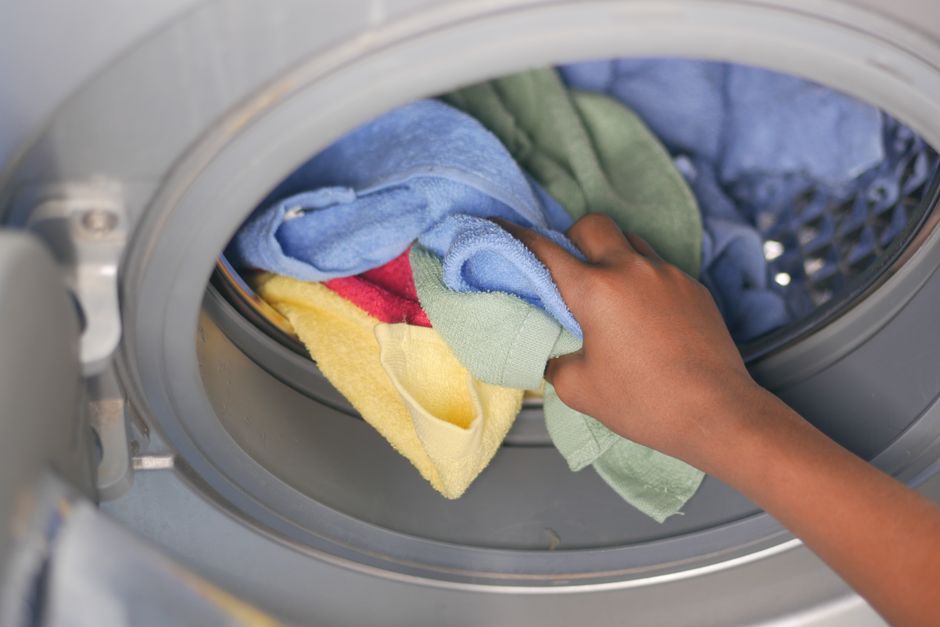
If the washer spends a long time at the beginning of a cycle or before a rinse, it may be waiting for water. A partly closed supply valve, a bent inlet hose, or a household water supply issue can slow filling. A restricted inlet screen or faulty inlet valve is also possible, but those possibilities require more careful evaluation.
Look behind the washer only if you can do so without straining a hose or moving a heavy appliance unsafely. Confirm that the accessible hot and cold supply valves are open and that visible hoses are not sharply kinked, crushed, or leaking. If other fixtures in the home also have weak flow, the problem may not be inside the washer. If the washer alone fills slowly after the simple checks, a technician can determine whether the cause is in the supply connection or the machine.
Temperature matters, too. A cycle that uses warm or hot water can behave differently when the incoming supply is colder than expected. Do not assume the washer needs a new heater or sensor because a heated setting takes longer. First compare it with a suitable cycle that does not depend on the same temperature setting.
A Whirlpool washer generally needs to drain before it can complete a full spin. If water remains in the tub, the cycle may pause, take longer, or fail to finish. A kinked drain hose, obstruction in an accessible filter on models that have one, drain pump trouble, or a household standpipe that backs up can produce similar symptoms.
Watch for water still visible after a drain attempt, clothes that remain unusually wet, a humming or grinding noise during draining, or water rising from the standpipe. A slow drain can look like a spin problem because the washer may not reach its normal final spin while it is still holding water. This is why replacing a spin-related part based on wet clothes alone can miss the real issue.
Check only the visible drain hose for a sharp bend and follow your model’s manual if it specifically provides homeowner instructions for an accessible filter. A filter opening can release water, so prepare for a spill and stop if you cannot do the task safely. Do not remove panels or reach into a pump. For more on this symptom, see our article about a washer that is full of water and will not drain.
When cycle settings, load balance, detergent, and visible water connections look right, the washer may be responding to an internal problem. Depending on the model and symptoms, possibilities include a door or lid lock that does not confirm closure, a water-level sensing issue, trouble with the drain system, a drive-related fault, wiring, or a control problem.
None of these can be confirmed just because the countdown stops. For example, a washer that pauses before spinning might be waiting for water to drain, trying to balance clothing, or failing to verify that its lid is locked. Appliance Repair Services recommends identifying the stalled stage and testing the related system before replacing a sensor or electronic control. An error code is useful information, but it is a starting point for diagnosis rather than proof that a named part has failed.
You do not need to watch an entire load from start to finish. A few observations can tell a repair technician much more than “it runs forever.” Note the selected cycle and options, whether the tub is lightly or heavily loaded, and what happens at the point where progress slows.
Before scheduling washer repair in Herndon, find the model number if it is readily accessible on the appliance label. Whirlpool makes different top-load and front-load designs, and the right diagnostic path depends on the model. Do not move a stacked unit or pull a machine out of a tight space just to read the label.

We suggest working from easy, external checks toward professional diagnosis. These steps can resolve a loading or settings issue and give us clearer information if service is still needed.
If the washer finishes a properly loaded cycle after you correct the detergent or settings, keep an eye on subsequent loads. If the delay returns, do not keep experimenting with increasingly long cycles to work around it. That can leave a drainage or filling problem unresolved.
Stop using the washer and seek professional help if it leaks onto the floor, gives off a burning smell, smokes, repeatedly trips a breaker, or makes harsh grinding noises. Water around an electrical appliance calls for particular care. Do not touch a wet plug or outlet; keep clear of the water and disconnect power only if you can do so safely.
Do not remove panels to inspect wiring, bypass a lid or door lock, or replace a drain pump, inlet valve, or control board based on a search result alone. Those repairs involve electrical and water connections, and several different faults can produce the same slow-cycle complaint. Appliance Repair Services can evaluate a washer that fills, drains, or spins poorly and explain which finding actually accounts for the added time.
Even without an urgent safety symptom, schedule service if a suitable cycle repeatedly stalls, the washer never reaches the end, water stays in the tub, or clothes are consistently soaked when it says it is done. Prompt diagnosis may help prevent an ongoing leak or repeated operation with a drainage problem from causing additional trouble in the laundry area.
Often, the answer cannot be determined from cycle length alone. A fixable supply, drain, lock, or balance issue may be quite different from a machine with several worn or failed systems. The right decision depends on the confirmed cause, the washer’s overall condition, part availability, and the cost of repair compared with a replacement that meets your needs.
Think about whether this is the first problem or one of several recurring failures. Check for signs unrelated to time, such as leaks, severe noise, or repeated inability to spin. Once the cause is identified, you can weigh the proposed repair against the age and condition of the machine. You do not need to decide to replace a washer simply because one load took longer than expected.
We cover that decision in more depth in our guide to repairing or replacing a washer in Northern Virginia. For a persistent Whirlpool cycle problem, diagnosis should come before a repair-versus-replacement decision.
Good habits will not fix a failed component, but they make it easier to avoid preventable delays and notice a genuine change in performance.
Our approach at Appliance Repair Services is to pair those homeowner observations with a focused evaluation. They can shorten the path to finding the cause, but they are not a substitute for testing when the machine continues to stall.
It may be trying to balance the load, clear excess suds, finish draining, or complete a selected option. Notice whether water remains in the tub, whether the load is tangled, and whether a message appears. If it repeatedly fails to complete the final stage with ordinary loads, arrange a diagnosis.
Yes. On models that show remaining time, the display is an estimate and can adjust as the washer senses conditions during the cycle. A changing estimate by itself is not proof of a fault. Consistent stalling, unfinished loads, leaks, or unusually wet clothes are stronger warning signs.
Yes. Excess suds can lead to extra rinsing or delays before spinning. Use the detergent type specified for your model, measure it according to the product directions, and take the size and soil level of the load into account.
The machine may not be draining fully or reaching a proper final spin. An unbalanced load can also prevent effective spinning. Check for standing water and consider whether the load was unusually heavy or tangled. If it happens with ordinary loads, a technician should check the drain and spin-related systems.
No. Slow filling, suds, drainage restrictions, load balance, and lock issues can all make a washer appear to hesitate. A control problem is possible, but the stalled stage and related components should be tested before any expensive part is replaced.
If the delay was limited to one overloaded or overly sudsy load and the washer now works normally, monitor it. Stop using it if you see a leak, smell burning, hear severe grinding, or have an electrical concern. Arrange service if delays recur despite appropriate loads and settings.
Appliance Repair Services provides washer repair in Herndon and serves surrounding Northern Virginia communities, including Reston. We can assess where the cycle slows and help you decide on the next step based on the findings rather than the symptom alone.
A Whirlpool washer that takes too long may simply need a better-matched cycle, a balanced load, or less detergent. If it repeatedly pauses, fills slowly, will not drain, or leaves laundry wet, there may be a problem that basic checks cannot resolve. Appliance Repair Services helps Herndon homeowners diagnose washer problems and understand their repair options. Call 703-782-4410 to discuss what your washer is doing and schedule appliance repair service.
